

There’s a conversation happening in marketing leadership right now that almost nobody is having honestly.It goes something like this.
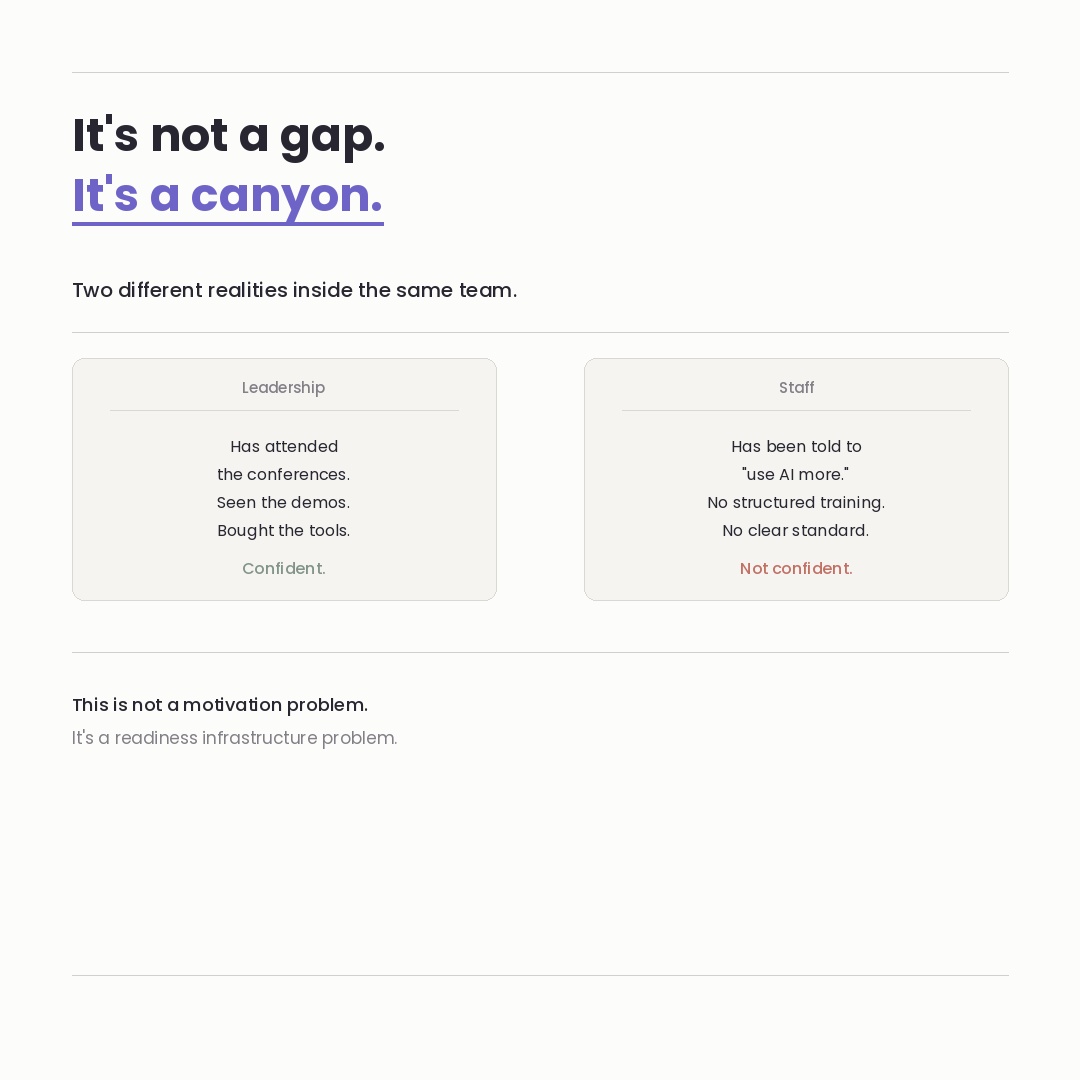
Someone asks a CMO: “Is your team ready for AI?” The CMO says yes — because they’ve attended the conferences, seen the demos, bought the tools, added AI to the strategy deck. They believe it. They’re not lying.
Then you go and ask the people actually running campaigns, writing briefs, managing client relationships, and pulling reports. And the number that comes back is 12%.
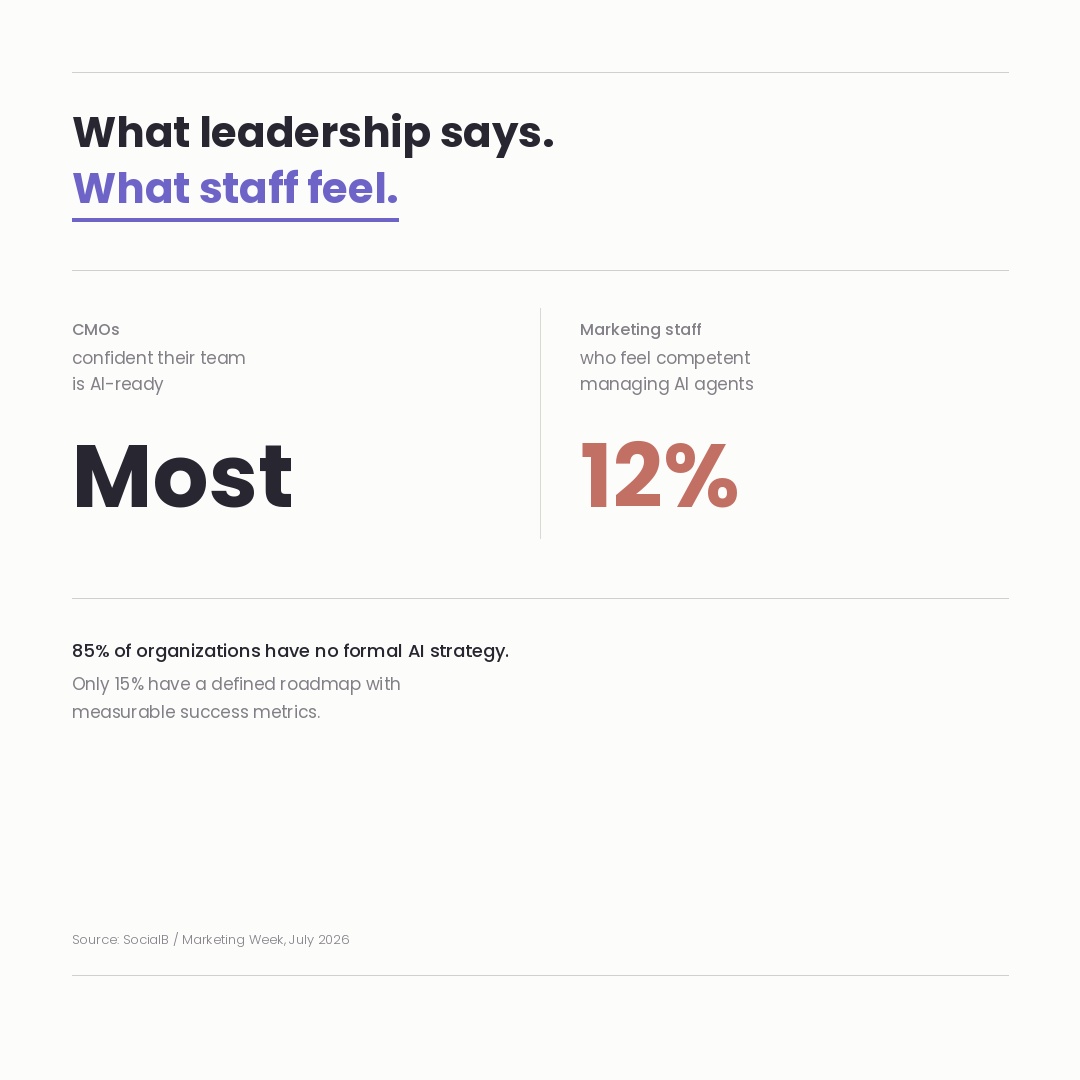
Twelve percent of marketing staff say they feel genuinely competent managing AI agents.
The same week this data landed, a separate report confirmed that 85% of organizations have no formal AI strategy and no clear ownership of AI initiatives. Only 15% have a defined roadmap with measurable success metrics.
Put those three numbers together ,CMO confidence, staff reality, strategy vacuum and you’re not looking at a gap anymore. You’re looking at a canyon.
Why the canyon exists (and it’s not who you think it is)
Here’s something I want to say clearly, because the easy version of this story is to blame leadership for being out of touch.
That’s not quite right.
Most CMOs I speak to are genuinely trying. They’ve done the right things: invested in AI tools, pushed the agenda internally, made the business case to the board.
The confidence they express isn’t arrogance. It’s what happens when you’ve done everything a leader is supposed to do and you’re waiting for the organization to catch up.
The problem isn’t that leaders are overconfident. The problem is that the work required to bridge that gap training, standards, governance, workflow redesign is invisible, unglamorous, and nobody volunteered to own it.
What’s actually happening to the people on the ground
Put yourself in the shoes of a marketing manager in mid-2026.
Your organization has purchased three AI tools in the last eighteen months. Your manager told you at the last team meeting to “use AI more.”
You’ve played around with ChatGPT. You’ve used it to write a first draft of something. Maybe you’ve tried a few prompts that didn’t quite land the way you hoped.
But nobody has told you
- When AI-generated content needs a disclosure
- How to tell whether the output is actually good, or just plausibly good
- What to do when AI confidently says something that’s factually wrong
- Which tool to use for which task
- How to document AI-assisted work in a way that’s defensible
You’re not resistant to AI. You’re not slow. You’re just operating without a map in terrain that changes every few weeks.
That’s not a motivation problem. That’s a readiness infrastructure problem. And it’s the most expensive invisible cost in marketing right now because teams are scaling AI output without the scaffolding to catch what goes wrong.
The pattern inside the 15% that are actually ahead
The organizations pulling ahead are not the ones with the most tools. They’re not the ones talking about AI the most confidently in their investor presentations.
They’re the ones who did something deceptively simple: they picked a specific use case, defined what good output looks like, built a review standard around it, and then replicated that structure across the team.
Not “use AI more.” Specific.
“Every brief written with AI assistance gets reviewed against these five criteria before it goes to a client.” That’s a standard. That’s reviewable. That’s teachable. That’s what bridges the canyon.
The teams still stuck in the canyon are the ones who bought the tools, sent the all-hands message, and assumed adoption would follow. It doesn’t. Adoption without standards is just chaos at higher speed.
Three things worth doing before your next planning cycle
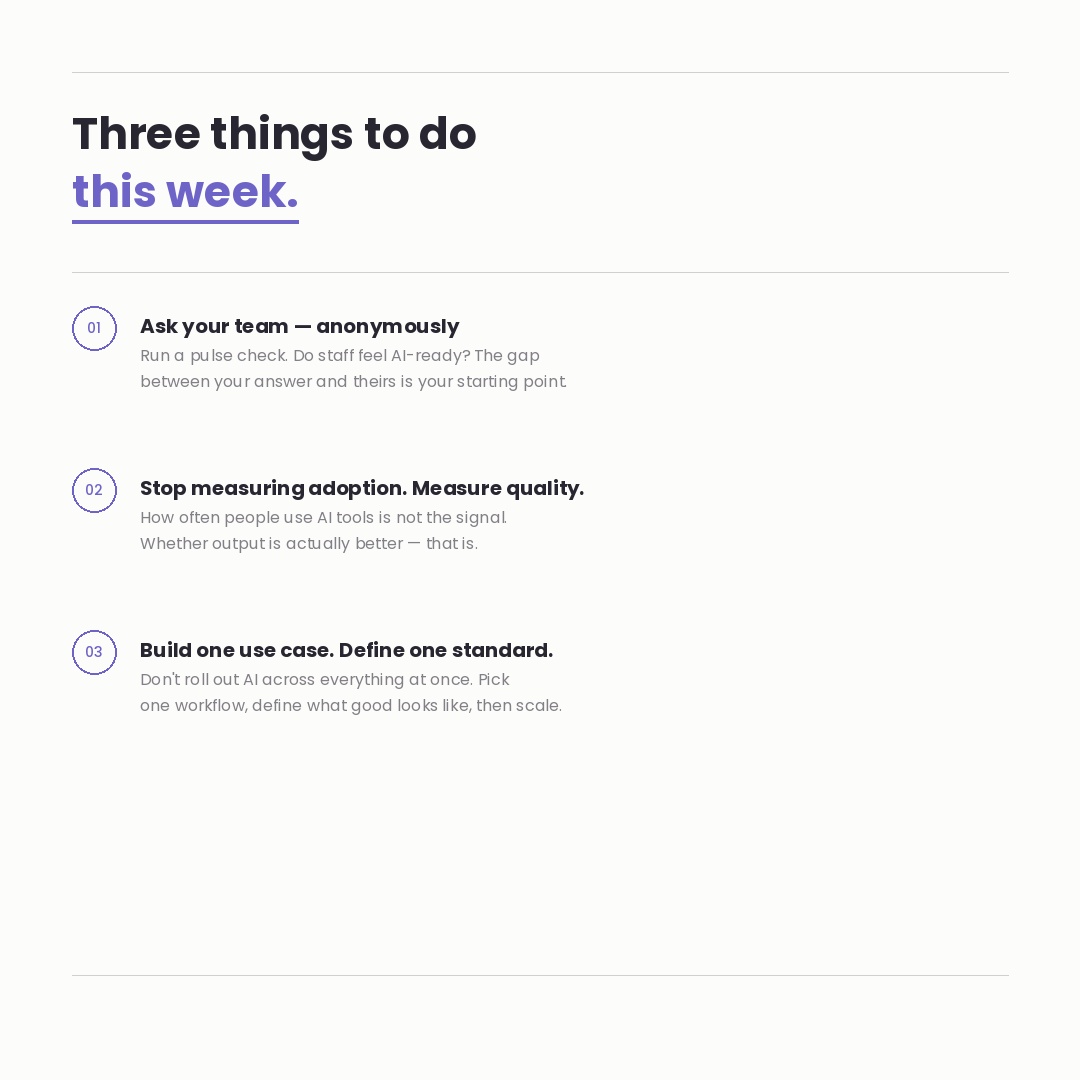
Ask your team anonymously and actually listen to the answers.
Before your next QBR or planning session, run a simple anonymous pulse check. Two questions: “Do you feel confident using AI in your daily work?” and “Do you know what good AI-assisted output looks like for your role?”
The gap between your answer and their answers is your real starting point. Not the strategy deck. Not the tool budget. The gap.
Stop measuring how often people use AI. Start measuring whether it’s making the work better.
Most organizations track adoption rates. Almost none track quality. These are completely different signals, and only one of them tells you whether the investment is working.
Define what “better” looks like for one specific output a brief, a report, an email subject line, a campaign summary. Then measure that. The data will tell you something the adoption rate never will.
Build one use case properly before you build ten use cases badly.
The instinct is to roll out AI across everything simultaneously. The result is usually chaos, inconsistency, and a team that’s technically “using AI” but not improving anything.
Pick one workflow. Define what excellent output looks like. Build a review step. Make it easy to do it right. Then use that as your template for everything else.
One use case done properly is worth more than ten done halfway.
The uncomfortable thing most people aren’t saying out loud
Here’s the part I’ve been sitting with this week.
The Skills Canyon is not primarily a technology problem. It’s not even primarily a training problem. It’s a leadership honesty problem.
The incentive structure in most organizations rewards confidence over candor.
When the board asks “are we AI-ready?” the answer that’s rewarded is “yes, we’re moving fast” not “no, we have the tools but we don’t yet have the culture, the standards, or the training to use them well.”
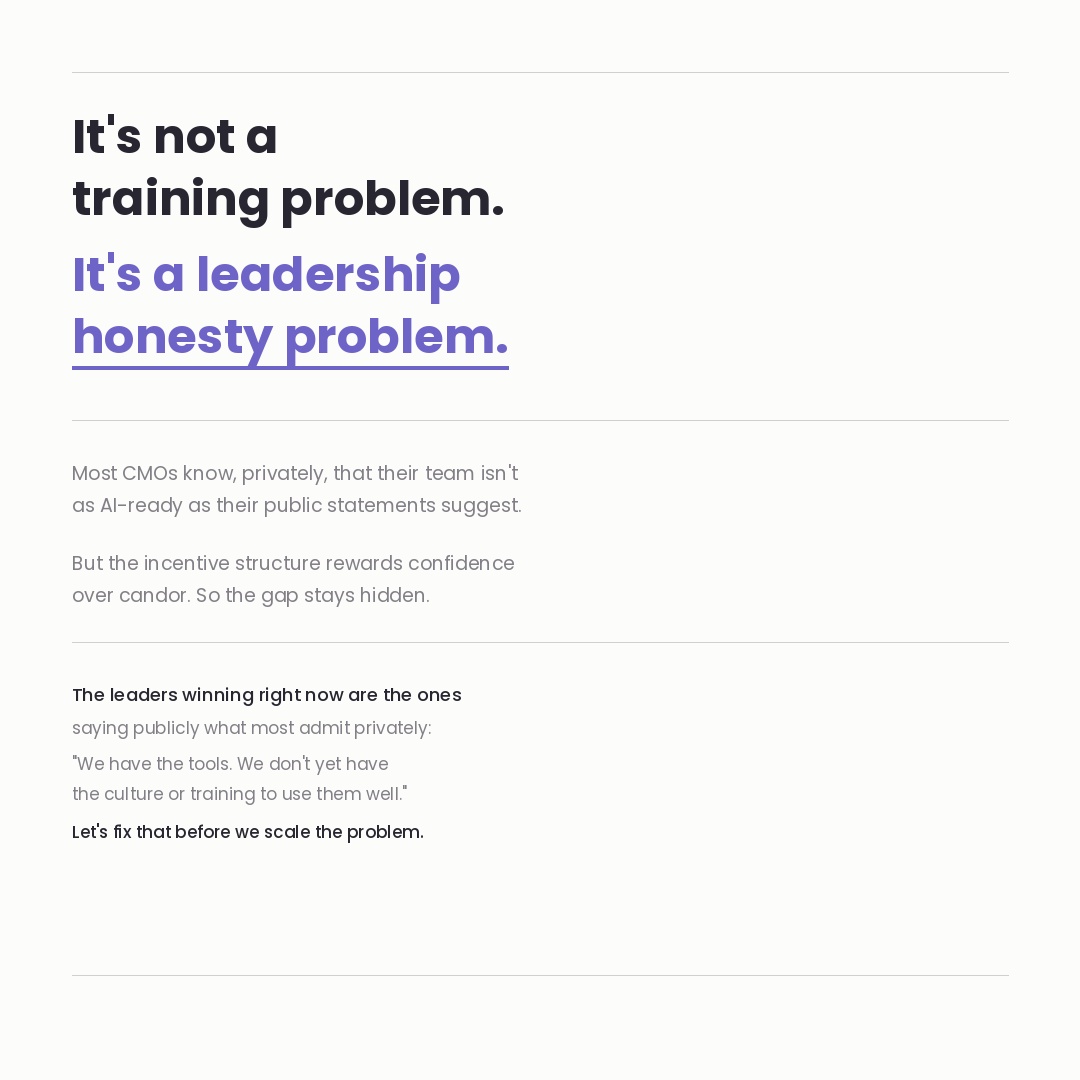
So the honest answer doesn’t get said. The gap stays hidden. And it shows up eventually in results in compliance failures, in AI-generated content that nobody caught before it went live, in teams that can’t explain their own work because they can’t explain what the AI did and what they did.
The leaders I respect most right now are the ones willing to say the uncomfortable thing: we’ve made the investment, and we’re not yet getting the return, and here’s the specific thing we’re going to fix about that. Not “we’re ahead of the curve.” Not “we’re transforming.” Just honesty, followed by a plan.
That combination honesty plus a plan is rarer than it should be. And right now, it’s the thing that actually separates the organizations that are learning from the ones that are performing
What I’d genuinely like to know from you
If someone asked the people on your marketing team , not you, them whether they feel genuinely AI-ready right now, what do you think they’d say?
I’m not asking what you want the answer to be. I’m asking what you think it actually is.
Drop a comment below. I read every one and the honest answers to questions like this are consistently more useful than anything in the research reports.